Wednesday, June 29, 2016

Burning Betrayals


Betrayals burn. Those betrayed get hurt, yes, but those who do the betraying possibly sustain
 more. An essence of one's integrity gets lost. It's as though the inability to keep a secret, or to hold 'the other' in sufficient value enough to protect private information they shared with you has worked its way through the core of you, renders you rotten. At least, that's how I feel. And I have betrayed in my time. I've let slip the secrets of yore. After all, the passage of time gives one a sense of ‘it’, the secret, surely 'no longer' mattering. For instance, especially if it happened many years ago, surely it’s alright now to reveal the misdemeanour; yet we can be surprised when there's adversity to long-buried news. Why is it that we instinctually know that some things of our past are best left hidden in their closets? Yet which of us has no closet whatever to be found in the long-ago recesses of our psyche? Which of us has never (ever) told anyone else the secret that someone else shared with us? Especially when that secret has no real relevance or chance of being found out; across time zones; across continents; across cities; across social circles? Yet, we do! We tell, we expose, and we are left littler for it! If you're like me, you burn for it. Your integrity over 'that' matter, like your virginity, can never (ever) be retrieved.

Some betrayals are innocent enough. My most recent one was promising my renters over a pre Christmas drink that I'd not break their verbal contract with me until end of lease, end of September, 2016. Well, by mid January I'd not only forgotten that promise, I'd let them know they needed to vacate by the end of May! When called on it, I was truly astounded! I truly actually-factually had (conveniently?) forgotten, overlooked, neglected, and not checked in with my ‘self’ to see if I'd made a prior commitment. And today, nearly six months later, I still burn, hurt, feel upset, and deeply regret my selfish shallowness of process. Yes, I did need to sell that particular property! Still, was it just symptomatic of the long-line of betrayals that suited me, that rode with me as I wound my way through a past, en route to here? My making amends, offering alternatives, extending apologies all helps ameliorate my short-fallings, yes, but still...

Integrity is not a product; it is a journey. We make hundreds of promises throughout our lives, and some we keep, and some we break. We are fallible. We serve others, or we serve ourselves, and oft times the discernment at which is the better action (to keep things a secret, to uphold a promise, to prolong the entrustment, or not) dogs us. Not all secrets are good. Not all protection of another does oneself good. Ask anyone who suffers child-abuse. Uncles and parents and siblings and family members may be served some protection at the expense of oneself, but should especially not be served at the expense of continuing freedom to perpetrate their awful influence on others! And so, promises and secrets are not always to be honoured. Little in life is truly black or white. Ask any lawyer. Life is full of circumstantial there-unto's.

Thereunto allow me to advance my apology to whomever is reading this, feeling that I've in my turn betrayed something they've held dear. I think of students who clung tenaciously to a separate Faith, (yet I did not belie them). I think of friends who expected more of me. I think of colleagues who wanted more from me in terms of my supporting the status quo. I think of spiritual warriors who may expect a purity of complete and utterly ‘correct’ actions. Yet we all are on a journey. To exist otherwise is to be in stasis. And I personally have “miles to go afore I sleep, and promises yet to keep, though venturing some woods can be lovely, dark and deep".*

Betrayal burns in me. I shall choose yet more carefully my words, my promises, my actions; amend my course of thinking, feeling, and being. But, my friend, Batman, now that you told me who you 'really' are, I promise: I shall not in turn let your true identity slip. In doing so, I know by past experience just how much it can hurt others. (Yet still, history may castigate me for keeping your secret.) Sorry to know. Sorry to say. Sorry to feel. Betrayal burns, indeed.


*the poet: Robert Burns

Tuesday, June 28, 2016

Suspended Disbelief


Why do we feel for what otherwise is foolish? Men and women in costumes, wearing makeup, and singing their songs in heightened states of fancifulness reach into us from across the stage, or the screen, and pluck at our hearts. We need reality to breathe; we need fantasy to create. And in both we evolve. Or do all our instincts arise out of a need for survival? Suspended disbelief has us glued to the TV, to the stage performance, to the musical we've heard before, and we will talk about made-up lines and fabricated lives as though they were real. Very real. Like the shadows in Plato's cave that we watch dance against the wall; we give credence and veracity and vitality to their existence, and are tugged by our identifying. How else to look for Nimo? What else but throw a Hogwarts party? Why else attend South Pacific and feel it resonate? Make-believe! Yet I cried at Mike Johnson's raw soul-filled pain in South Pacific, on Saturday night (even though I too played that same part of Emile de Becque, twelve years ago.)

To construe, to imagine, to lie through the teeth, to create; these are the verbs by which we move mankind. Nouns by themselves have no life. They need a soul; they need a verb to live! Like formal sentences. A formal sentence can only be attended by a subject and its predicate. Boring! (Ah, but don't adjectives and adverbs really enliven life?) Yet it is not the nuts and bolts that really gets us, here; it is the feeling we feel when we give attention to that which, when made by man, is really not real. Images, artifices, icons, verisimilitudes, and bric-à-brac; it all can attract us, can elicit emotion, can start a collector on a pathway of addiction. (Which of us easily could miss an episode of, say, Down-town Abbey?) Identification is all! And what if you've never seen or heard of South Pacific? A young female in our animatedly acculturated company, in her 20s, had never heard the song, "Some Enchanted Evening," let alone been given the gift of Cable's profound reasoning: "You've got to be taught to hate the people your relatives hate!"

Or am I being too pedantic?

Yes, creativity is about fun and catharsis; a measure of pleasure to detract from reality. Does it have to be didactic? Does Creativity have to have a lesson, a meaning, a purpose other than to entertain, to make money, to provide surcease from the steady strife of reality? Yes, ‘a steady strife’ it is, this learning of formalities and correctness of behaviour and thought and expectation and rule and custom. How else did we arrive at the tragic shooting of the 49, earlier this month? How else did we sustain the Holocaust, the Crimean war, the War of The Roses? All of history is too full of reality butting up against reality for us easily to live without strife. We must needs populate history with the re-telling, such that we put words into the mouth of Anne o'Cleaves, or think we know what Beowulf himself felt, and then take someone else's' imaginings for reality!

How easily to distinguish between truth and fiction? How easily to allow oneself transportations of emotion during a musical about the five daughters of Tevye, or the seven Grooms for seven Women? How to disbelieve those who tell you 40 virgins await? How to unlearn the pain-body of history that says my Afrikaans fore-bearers were fed ground-glass in their porridge in British prisons, and that's why my mother's family hated my oh-so English father! How to let go being a
Jew or an Arab or a Black or even a man or woman and just be a Person? How else but...

"You've got to be taught to fear or hate, you've got to be carefully taught!"


Reality, creativity, thinking, and feeling; it all is one. "Nothing is good or bad but thinking (or feeling) makes it so," the poet admonished. Yes, creativity needs not be didactic. But at the very least it is best deployed to create a sense of universal compassion and care and responsibility, advancing our very evolution; or do we merely stay fools, lighting our way to dusty deaths?

Tuesday, June 14, 2016

Acceptance is All


Things die. Ideas, hopes, dreams, aspirations, animals, people. Sad, yes. Also, natural. What is there that has outlasted its immaculate self, its best self, its prime self? Yes, there's restoration and preservation. Yes, there are monumental embodiments of mans' deference to existing. But eventually? Look on my works, time, and see the dusts of disrepair. We all die. Everything, eventually, is replaced. It’s there, or it isn’t.

Like the Canada Goose I saw stumble, and fall. Had it not been in the road, in front of a bus, other accidents might not have happened. But the unforeseen obstacle, right where a busy intersection had customary traffic plying away at the hustle of needing to be somewhere else, created a consternation of calamitous proportions. Tires screeched. Brakes squealed. Did fenders bend? And the goose, unable to move, seemed shocked into non-reaction, resigned to accepting its fate. But since my vehicle was not in its lane, I steered cautiously past, and was soon away (again).

We are affected by all that goes on. And we affect so much more than we normally might imagine. Our actions have an impact that creates the chaos of fragmentation, disintegration, and the redirection of an otherwise usual flow of things. But not all is negative. We may well fly like butterflies and sting like bees, but we might in our wake engender a great deal of positive energy; create a climate of loving actions. Because one brakes for the deer that unexpectedly crosses the road, might one also not be at that crossroad when the goose falls? Perhaps not be at that coincidental spot on the road when from between parked cars the five year old girl runs out to retrieve her errant ball!

Thing is, there is a difference in responsibility once one knows the possible consequences of one's actions. Whether an individual, a group, a populace, a city, a nation, or even a species, we humans know better! Yet we persist in overpopulating. We persist in plunder and pillage and even raping our natural resources. We persist in divisive and hateful polemics. We persist in war and terrorism and avenging the past. We persist in greed. We continue to use and abuse and want more and more. I do. Do you? It is deep in our nature not to be able to stay small and self contained and satisfied with seeking, beyond sustenance, inner peace. The answer appears always to lie out there, somewhere, away from where we are. So we venture out and change our geographical locations, our familial ties, our familiar ways, and we challenge (or build) walls, and cross borders, and assume a new citizenship (at least, I did), and generate with our being a whole host of consequences that affects the traffic and the flow and the lives of all those who each must make some slight recalibration in their very existence to accommodate the fact that you too are on the road. It's natural. But does it have to be a Carson-ian 'Silent Spring'?*Thing is, once you know that you affect others, you become yet more responsible for your actions!


Drunk drivers are an example. They show us how seriously maligned our sense of responsibility can be. So too for petty thieves. So too for each act that breaks ethical sensibilities. So too for the malcontent that no longer gives a damn about the noise he or she makes, or the bumping and bruising created by barging through another's psyche. We go quiet in the presence of hummingbirds. We teach children not to shriek with excitement in the presence of nature. We teach respect, accord, deference, gentleness, compassion, and love. Why is it that, generally, there are so very-very many who do not get that lesson? What happens to make people shoot and kill and harm and vilify and denounce and segregate and go to war? Is that what Lieutenant Cable cries when he sings "teach your children"?** Just where does history end but in the death of everything that exists, and the giving over to something else that in turn, too must die. Such is history. It alone, 'lives'. Acceptance is all, indeed, but in the meantime....  Take care!

* Carson, Rachel (1907-1964): Silent Spring.
** Rodgers and Hammerstein: South Pacific (the musical).


Tuesday, May 31, 2016

Simple Sighman and The Pieman


Simple thing, this living. You take nothing personally, you choose words impeccably, you assume nothing about everything, and you do your best with what you have and where you're at. That's it. No muss, no fuss. No controlling of others. No ulterior motives. No in-authenticity. No complications. Simple!

And then there's living. We want things. We need things. We desire. We dislike, despise, and denounce. We have passion, certain insight, experience, and un-deniable facts. We cannot let someone take our identity away. We each are unique. And yet...

Yet we apportion ourselves (and others) into neat striations of pie-charts and colo(u)r bands and 
Hierarchical-Templates. We adhere to Astrology. (Cosmology, naturally, appears too complex). We give ourselves birth signs and labels. We perpetuate the fragmentation of an ‘I’ versus ‘You’, and an ‘US’ versus ‘Them’. Each of us is an individual! Yet we at the same time look for bands and congregations and collaborations of people to whom we can give our accord. Birds of a feather flock together¹. "A fish and a bird may marry, but how will they live together."² And we participate in pogroms, in divisiveness, and party memberships. How else to be a Donkey or an Elephant? How else to be a Bear or a Dragon? How does one be a Beaver or a Loon? What country shall I say I originate from? Just who am I?

There are sufficient questionnaires developed to derive an answer. Who are you? Vocational counselors will give you advice. So will your parents, your family, or your church. Psychologists will have you check-in your Family Constellations. Psychiatrists will assess your very chemistry. And your culture will give you an accent, a set of conditioned expectations, and even a birth-right. Your identification papers, your numbers (especially your SIN number) will give you a social insurance against being ‘a-nobody’. (Imagine being a refugee, sans papers, sans proof, sans money, sans ability fluently to speak a new language?) What if you were sans technology let alone manual-skills-sophistication? Imagine taking a Kalahari Bushman and dropping him in New York?

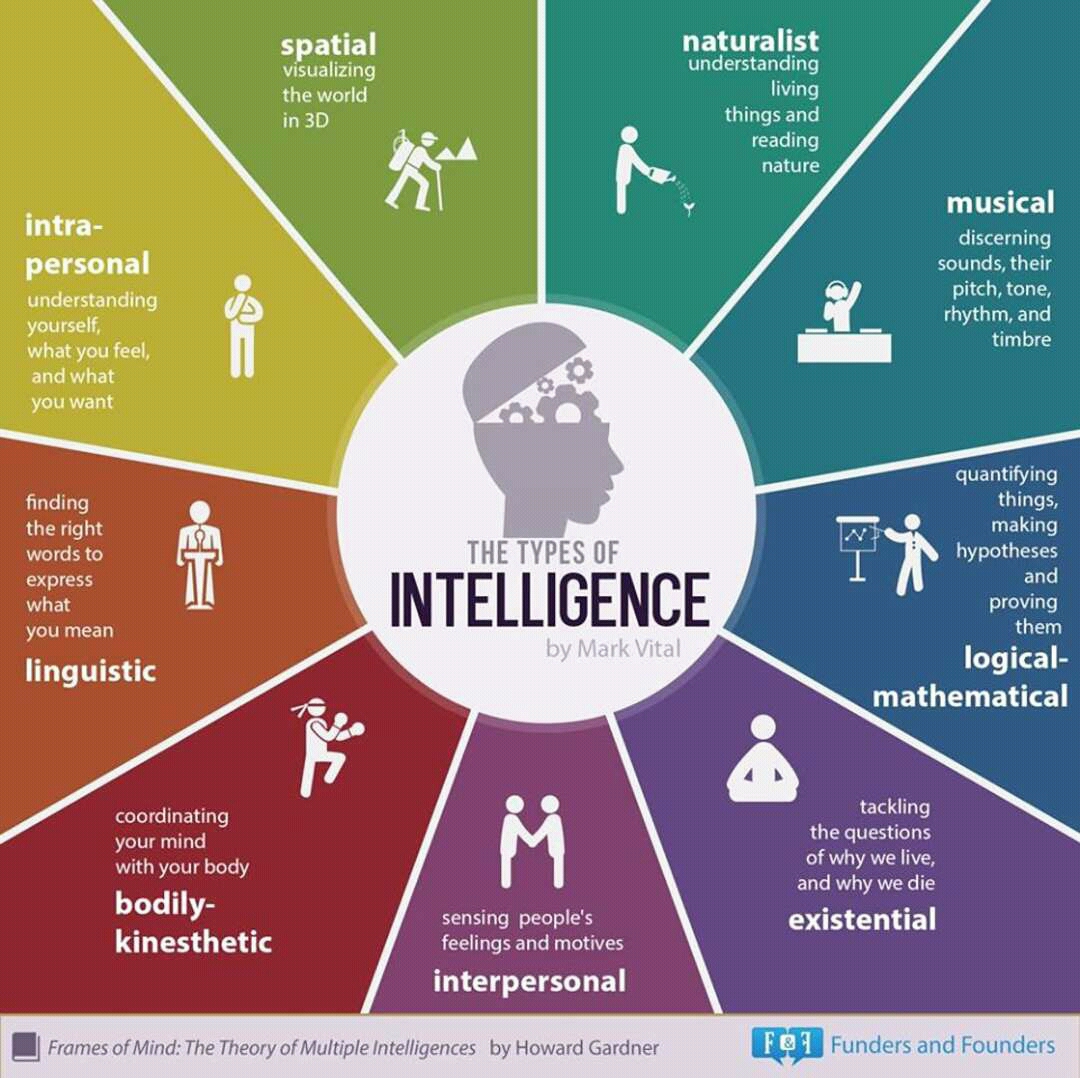
And yet some charts will have you left without hope in their strange delineations of identity. Like looking at a map of the world and realizing you've only ever lived in one city. Perhaps you've been lucky enough to travel a bit; seen some of the world. But at the end of the day, you and I both resort to the life we know, the life in our immediate surrounds. Naturally. And so it is with Intelligences, we presume, especially as delineated in Howard Gardiner's heuristics. We resort to using one of them, predominantly. At issue is, depending on our way of viewing things, is there a chance we might not develop, exercise, or strain our other faculties? Do we have to get our 'knickers in a knot'? Must we be anxious when the occasion does not suit us? Must we give up when stretched beyond apparent capacity? Where's our entelechy, our inner drive?3 And worse, must we adjudge others when we see them not able to do what we (so readily) can do?

Thing is, at any time we forget we are a “whole human being”4, or worse, that so is another, we create for ourselves a microcosm of myopia, malcontent, and miscegenation. We are a murder of crows, a gaggle of geese, a babble of sheep. We cease to think truly independently. We cease to realize we are multiplicitous, multifarious, and universal. As such we easily become less global, less provincial, and even less countrified. We descend into the relative obscurity of a citizen of the city, un-noticing and unnoticed as we get counted among the moving masses; a bland face without being recognized as "petals on a wet black bough."5


You see, life ain't so simple after all. After all, which part of Everything is not? (Sigh?)

1. Holland's Theory
2. Tevye (Fiddler on The Roof)
3. Morrie (Tuesdays with Morrie, by Mitch Albom
4. Essential Entelechy (http://mrpswords.blogspot.ca/2016/05/essential-entelechy.html)
5. Ezra Pound

Tuesday, May 3, 2016

Essential Entelechy


"How do you make six halves out of one whole? Well?" And so, similar questions plague us.

Entelechy* keeps us at thinking about it. (Yes, it's a Greek complexity.) According to some, the degree of entelechy (an innate drive) determines a person's potential, or not. We are of a mind not to yield, not to give up, always to progress, or not. (And no, perseverance here is not 'obsessive-compulsiveness'; it is more about determination and endurance.) Most of us, it is deemed, simply accept the acculturation and habits of our forefathers (or mothers). We are not innately driven toward more insight. Rather, we give more energy to acquisition. Awards, trophies, products, and even Enlightenment is seen as an attainment. More is better! And the more readily we give our energy toward any given product the more readily we may be seen as one who 'makes the most' of himself. (Herself too). Thing is, entelechy has more to it than that. It is an integrative-force. (Some have called it a soul-force.) And controversial as it is, it enlivens our life, all our lives, known or not.

Metaphorically, we may be adjudged to be a Volkswagen, Porsche, Chevy, or perhaps a Pontiac. (Rolls Royces, we learn, may not be all they're cut up to be). Thing is, some say one can only hope to be the very best vehicle within which the stuff of ourselves is made. (And here the analogy falters, seriously: A real Volkswagen cannot wish itself into being a Jaguar.) Then too, vehicles eventually die. They go to scrap heaps and mayhap get amalgamated, refined, and may even reappear on the roads in altogether a different form. Some older vehicles are nourished and protected and safe-guarded and valued. But most have a predictable life-span. Yet most, even as old rust-heaps, remain recognizable. Humans too can alter shape, change engines, disregard traffic regulations, and are not confined to being one brand over the course of their lifetime. At least, certainly not all humans.

Outliers are defined as those who noticeably differ from the norm. Take Paul McCartney. At 73 he gave a concert that went seamlessly for over two and a half hours last night [April 19th]. The Vancouver Rogers Arena crowd of a staggering 16,000 people was thrilled. Tonight he does the same. He has what the New Yorker calls, 'resilience'. ** It is that quality that allows some individuals more easily to surmount their difficulties. And they do these things not so much with the help from friends and family, and even others, but with the inner fortitude of survival stamped so deeply within that it is as though they retain all the competitiveness of the atavistic sperm of their origins; they will make it! The best they can be! (**A link to the 'resilience' article is below.)

But here's where the 'kind of car we are' analogy really breaks down. It's not just survival, but familial bonding, egocentricity, socialisms, ambitions, and globalism that drives some of us toward higher and higher predominant proclivities. In other words, we tend toward operating generally from one of those hierarchical paradigms (let alone predominantly acting from a paradigm of Integrative Enlightenment). And so, if we keep with the concept that we're bicycles or scooters or motorbikes, let alone lorries, or taxis, or buses, we can easily be dismissive at seeing another in what we see as their 'active construct'. We may assert inherent limitations on their innate potential. Sadly, so may we also limit ourselves! We give up on our interests, waste our passions, or distract ourselves with the side-streets and window-shoppings of life. How to go from being "just a Mini" to becoming a Maserati? ("And why bother?" the bell-curve begs.)


We are divisible, top from bottom, left from right, front from back; that's six halves of one whole. (And so on.) But there's more. We're so multi-faceted as to be an amalgamation of very many experiences and insights and potentialities. Our inner resilience, our determination to do for ourselves yet more than that which has been done unto us, or for us, is the very stuff of a limitless entelechy.  It is the inner stuff that invigorates us when we're tested, rather than it enervating our sense of individuality; that's entelechy. (And if you've read this far, you're more than half interested! Ha!)

* Entelechy: Linda Silverman's Counseling The Gifted & Talented, pp. 44-46


Thursday, April 21, 2016

Granny's Games


Granny still lives! At least, as a "construct" she does. "Brain play" is the issue. We humans make things up and believe them, and then we give credence to their supposed significance and pray to them, pay obeisance, and even sacrifice our natures to their perceived wants. Is that not what the Greeks and Romans did? They took their beliefs very seriously! But now we study their gods, and even dare scoff at their ignorance, their fanciful-mess, their ignobility!

Yet...

Granny was spurned by me. We were across the country being driven from having a maple-pancake breakfast and still dreaming of securing this new place at Selleck Way when I dared, from the back-seat, scoff: "As if one's ancestors are leaning over one's shoulder and guiding you!" In that moment I was more-keen to support the existentialist driving the car than I was being sensitive to the supportive spirits hovering around my sensibilities. My old friend the driver conjoined: "Yes. A bunch of molecules and atoms; all dispersed and unidentifiable, that'll be me. End of story. All else is Brain-Play!" Still, at that moment in the car something dire enveloped me. It was a foreboding. Poised as we were on the precipice of a delicate financial negotiation to secure our desired new home, I'd proven sacrilegious. I'd denounced my Gran-(nee) Selleck! And what's more, the other persons in the car knew precisely what and whom I was talking about! Still, I doubt that any one of them felt what I felt. They perhaps gave it no more thought. But all the rest of that day, my betrayal of my Granny lingered in me.

'Selleck Way' had struck me as providential from the outset. The street with my Granny's maiden name on it had guided me toward my new abode! Surely it was a sign? (And more than just a signpost, ha!) Surely Granny Selleck, my dear long-departed 'Dorothy', was monitoring me, steering me to more-better choices, being an angel in my care! But did I care back? Did I offer her sufficient gratitude? Did I acknowledge her 'presence' and her guardianship in my life? Well, certainly I did by telling my closest ones of the coincidental name! Certainly I did by telling my wife, my brothers, my sister, just how pleased I was to be living, potentially, on Selleck Way.

And then the deal fell through. That same night of my having denounced Granny at breakfast, all of six months ago, the email came through from the Realtor. We'd lost the deal; the prospective buyers of our old place were not able to get their grand piano into it, and so their conditions were not met. And we were back to 'square one.'

Square one. It's as though life itself is a game. We negotiate and create contracts and pray that our needs will be met. We bargain and manipulate and orchestrate and manage. We are not the product of our own making (only); we are the product of chance and coincidence and influence and 'who one knows'. And that Granny was so linked to Selleck Way and that I'd mocked at her influence was the reason, I felt it somewhere in my bones, that I now had lost the opportunity to purchase my dream home! And on the aeroplane, the next day, going back across the country from our visit with our friends near that maple farm, I sent hopeful thoughts toward Granny. I sent little prayers of contrition, of apology, of regret. Somehow, I felt, I was in the wrong.


It took nearly six months before the reversal of our ways. With our old house at last again sold, we yet again bid on Selleck Way, and won! Yes, Granny has been very gratefully acknowledged along the way. Thing is, those same 'across the country' friends recently visited, and though his 'brain-play' became a Granny-Game about Much-Ado, it was our conversationally re-construing co-valent bonding that left its mark. Atoms conjoin. Ghosts hover. Angels abound. Throughout history spirits (and demons) and Left-and-Right and the intersection between them has plagued mankind. Been a heart-hurt? Yes. Yet manufactured Saints and Santas and Goblins and Fairies invest themselves. So too for all our gods galore. Brain play? Indeed! 

Sunday, April 17, 2016

Eminence Arriving Imminently!


Out damned spot!

Anxiety invigorates the moments. Guest are about to arrive! Did Ben Hur receive such a welcome? Did Alexander? What of Caesar, or Napoleon, or even Hitler? Were palm leaves not spread before the passage of Jesus? Which house was not prepared for guests? Which city does not take into account the imminent arrival of eminent foreigners? Who does not think of the right food, the right drink, the right bedding, the cleanliness and tidiness and presentation (if not perfection) of at least one's best? We do try to impress. We do want to please. We do hope to make our guests comfortable and at ease and so satisfied that they may even come back! (Above all else, let us not be shamed.) Anxiety dictates the preparations; if not the presence of the moments we have with a guest. Let's give 'em a parade! And at best, everything looks as if it was easy, as if 'regular'. (Paint the slum.) After all, isn't this the way we 'always' live!

The shells with which we clothe ourselves can be complex indeed. We do not like to be seen naked, let alone vulnerable. The unexpected knock at the door can send us scurrying to tidy up, if not ourselves, then at least our hair, our living rooms or our kitchens. A single speck on the floor can have us bending, even at the last moment, to retrieve the strand of hair, the crumb, the dried-up drop. We'd prefer to be spotless. Is that what the concept of original sin gives us, this sense of being so imperfect that we must scrub away at every evidence of our living existence, as though we leave no footprints at all in the warp and woof of time? Our exoskeletons are built to belie our innards. We puff ourselves up in finery and pomp. We paint our walls and decorate the doors to our private parts of life. And those we do let inside, we show most preferably that which we want them to see; meanwhile the closets hide quantities of the untidy and the unresolved and even the indelicate. Who wants to see our dirty laundry? Who wants to inspect our soiled cloisters? Who dares invade our closed cupboards? Yet which of us does not have the very swirl of life's necessities attending us? We are perpetually caught in the need for balance between what is, what is desired, and what can be obtained. History itself grew into us with the evolution of our needs; we deceive and lie and exaggerate. As a collective we understand these implicit things. But as individuals? It remains an issue of comparisons.

Outward appearances perpetuate one's position in the status quo. The lawn is mowed, or not. The car is washed, or not. The type of car itself can be an issue. So too can the state of one's garden. It all is referenced to the self; it all can be taken so personally! One has 'made it', or not, by comparisons, most usually. And somewhere deep inside, perhaps subconsciously, one is driven to anxiety over whether one really does meet another's expectations. Paradise lost? A mother or father's inability unconditionally to love? A series of being bullied by others, by the media, by society itself? We live in states of inauthenticity for the sake of serving expectations. If not entirely because of our own making, then because of wanting to please or obey those in close relationship to us. "Go clean up your room; guests are coming!" has an enduring ring.


Yet surely the conventions of compassion, courtliness, fellowship, frankness, and purity of mind ought to suffice for any meeting between oneself and an 'other', no matter the hierarchical stance of their eminence. Surely we needs but be authentic, sincere, and caring of any other, with little fear that they will judge our city, our village, our house, our attire, our furniture, or our place of living. Surely? Still, afore any guest's arrival, we clean up, tidy up, and ensure that all is 'perfect' for their presence. (Still.) Thing is, how to do so without the attendant anxiousness, without the evident subjectivity of worrying about the recipients' opinion of oneself. How best just to give accordance to an 'other's' presence, and let the chips fall where they may, surely? Then again, oh dear, surely I didn't miss a spot?